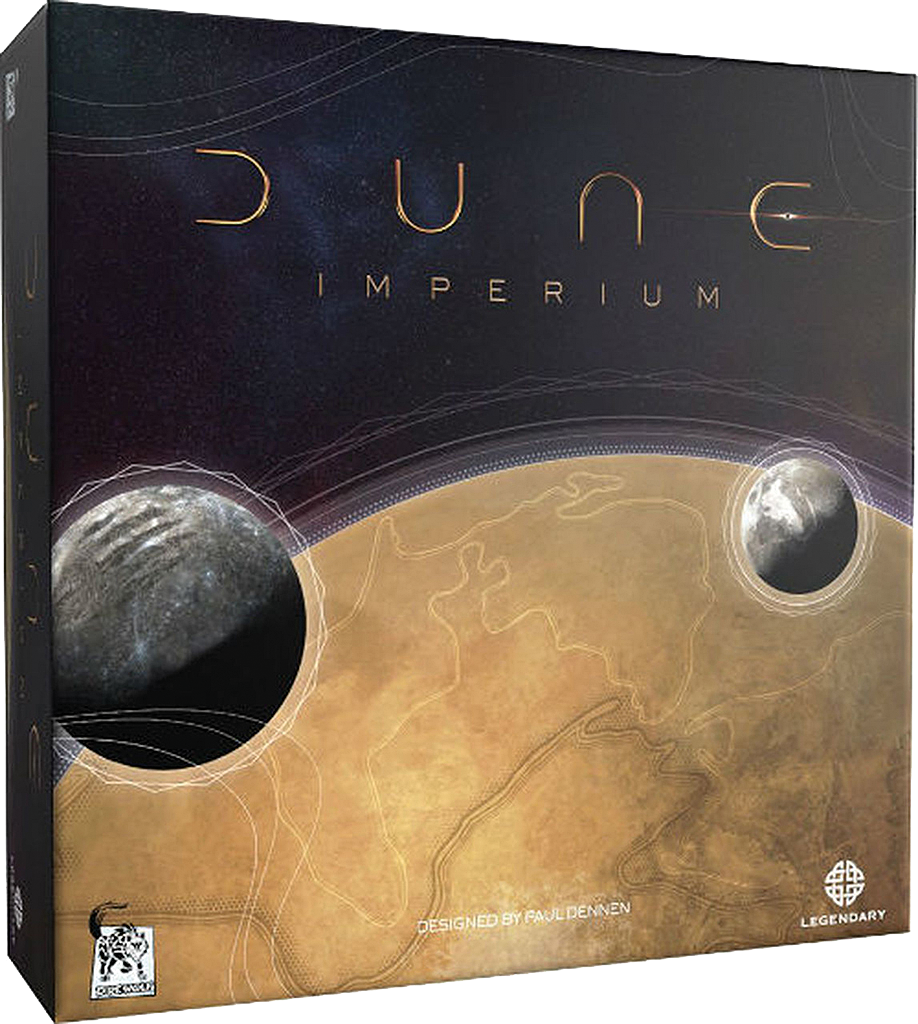
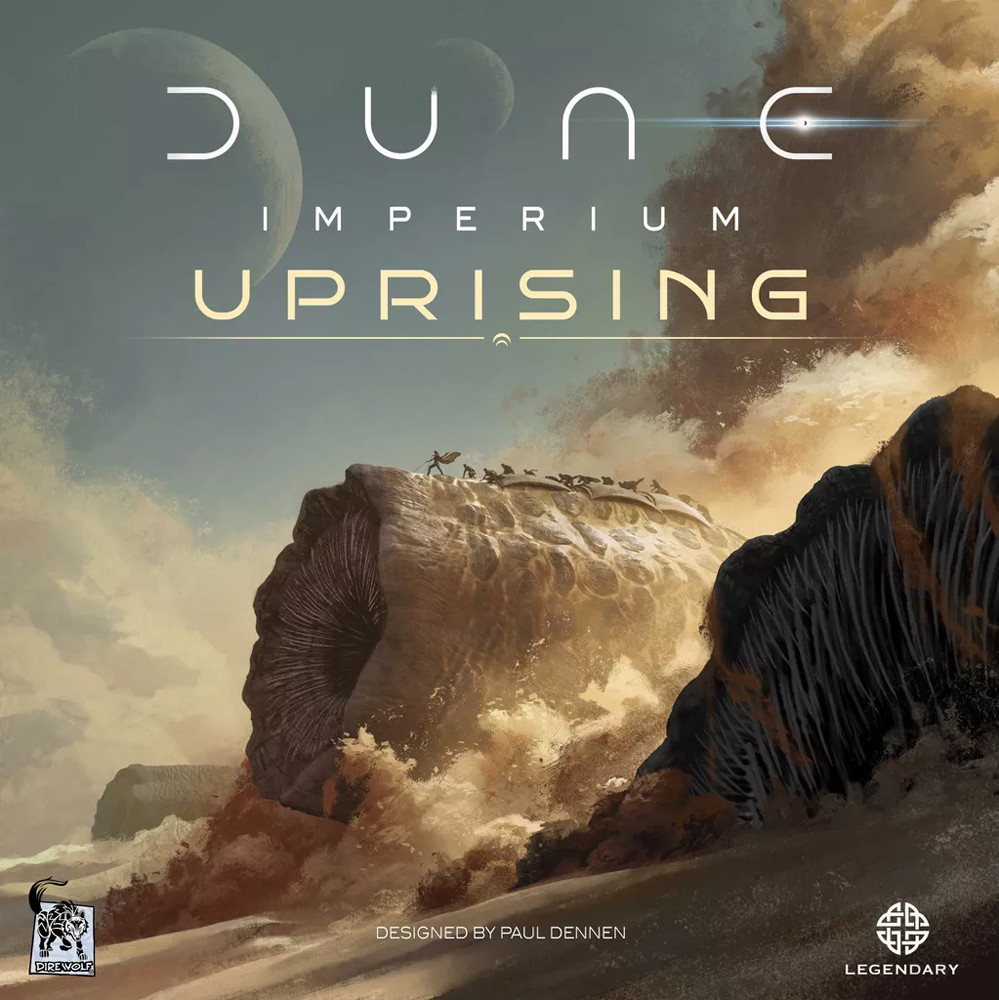
Expansion or Remix, What’s the difference between Dune Imperium and Dune Imperium Uprising?
Cards on the table, I’m a massive Dune fan. I think the (first two) books are masterpieces and I adore Denis Villeneuve’s film adaptation. Dune Imperium was an easy sell for me; I’d buy just about anything with a sandworm painted on it. It was such an easy sell that I didn’t even buy it. Dune Imperium was gifted to me by a friend who knew that, for me, “Dune + Boardgame” was the easiest slamdunk birthday gift imaginable. Unsurprisingly, I think Dune Imperium and Dune Imperium Uprising are both great, but I’d like to add the caveat that I’m biased and I don’t think these games are for everyone. In this review I’ll try to help you understand the difference between those two games and whether or not you’re someone who will enjoy having it in your collection.
First of all, why are there two games in this review? Dune Imperium was released by Dire Wolf studios in 2020 to massive success and acclaim. Dire Wolf quickly released two expansions, Dune Imperium: Immortality and Dune Imperium: Rise of IX, which were also well received (though I have not played these). Then, in 2023, Dire Wolf threw a curveball with the release of Dune Imperium: Uprising. Despite matching the naming convention, Uprising is not an expansion. It’s also not a re-release or promo edition of the original. Uprising does expand upon its predecessor, but it's designed to be played on its own. The closest concept is probably a remix: we’re playing the same tunes–the same rhythms and lyrics–but the tempo is different and the vocals are pitched an octave up.
Reviewing Dune Imperium and Dune Imperium: Uprising is strange. While they are genuinely very different from each other, their core similarities make it hard to imagine a player who’d enjoy one but not the other, like how someone who doesn’t like the new Taylor Swift album probably isn’t going to suddenly enjoy the remixed version. To help structure this article, I’m going to start by discussing the features that are present across both games. We’ll call that imaginary game Dune, and if Dune sounds like a good fit for you then the rest of the article will help you decide between Dune Imperium and Dune Imperium: Uprising.
At its core, Dune is a mashup of a worker-placement and a deck-builder. For those who don’t speak boardgame geek, a worker-placement game sees players take turns sending a limited pool of wooden workers to various spots on a board. Depending on the location you chose to send it, that worker will bring back a certain kind of resource (e.g. send a worker to the desert and she brings back spice). In most worker-placement games, sending a worker to a location blocks other players from sending workers to that location (e.g. the desert is occupied and nobody else can get spice this round). The puzzle of these games is created when your plans for resource collection are interrupted by your opponents choices, forcing you to improvise on the spot.
Worker-placement games like Dune are defined by the quality of the board. Designers have to walk a fine line when balancing each location workers can be sent to. If the location rewards are lopsided, then winning is just a race to lock up the best spots first. On the other hand, if every space is about equal, then it becomes pointless to try and lock other players out of certain options. Dune walks this line masterfully. The board has a dazzling array of options that interlock through a complex web of economic relations. Some spaces turn water to Spice, others Spice to Solari. Spice and Solari can be converted to all sorts of different bonuses and advantages. Players quickly branch out into specialized goals, but everyone needs to dance the dance of those three main resources. The economic process is long enough that everyone can make progress on most rounds, but shrewd players can predict what their opponents need next and throw a wrench in their plans. The atmosphere is tense and calculating, a good fit for the setting! The planet of Arrakis is characterized by various political schemes crashing into each other as factions vie for control of spice production. Dune’s board likewise rewards prediction, subterfuge, and improvisation. It’s a tight knot of tactics with a good rhythm; rounds tend to be short and sweet, and each is capped off by the lovely game of chicken that is this game’s combat system.
Each round in Dune sees a new card revealed from the conflict deck that offers spoils of war to whoever can muster the most troops. In the early game, rewards are small, and victory is often not worth it if it requires diverting too many resources to troop production. These rounds often play out like a hand of poker, where players try to bluff each other out of the fight with aggression or lure each other in with feigned weakness. In the late game however, where rewards decide who secures the final victory points of the game, battles often become massive demonstrations of military might. With few turns left in the game, investment in the future is useless, and players compete to see who’s economy is best at dumping unbelievable amounts of troops to the board. It’s another way Dune’s mechanics follow a satisfying narrative arc.
Speaking of economy, the other half of Dune is a long term strategic game moderated by its deck-building system. In a deck-builder, each player starts the game with a deck of cards that they draw a hand from each round. In Dune, these cards are what allow you to send workers to the board. “Dune, the Desert Planet” lets you send workers to the desert, while “Diplomacy” allows you to send workers to parlay with the Emperor or Spacing Guild. This means that players aren’t only limited by other players in where they send workers, they also have to contend with the luck of the draw.
Over the course of a deck-builder, players manipulate the composition of their deck by adding or removing cards. For example, If a player has a strategy that involves frequently visiting Fremen and desert spaces, they can try to add cards that allow those placements and remove cards that don’t, increasing the probability that their drawn hand will facilitate their gameplan. Certain cards can also grant players special abilities or bonuses, and much of the fun of Dune comes from experimenting with these cards and trying to find powerful synergies.
I love deck-builders. I’ve played Dominion and Slay the Spire since I was a child, and I really appreciate the way the genre rewards thoughtful strategy while also forcing you to think on your feet and improvise. No matter how well you build your deck, you can always draw a bad or clunky hand and it's up to you to make the most of your situation. I was really prepared to love Dune’s deck-building too, which is why I was so surprised that it ended up being my least favorite part of the game.
It’s not bad, to be clear, Dune’s deck-building is perfectly functional. I think the design of the cards is especially good, with unique effects that are difficult to evaluate on first pass and fun to experiment with. The bespoke art on each card is also wonderful. Both the Dune Imperium and Dune Imperium - Uprising decks (yes they are different) are lovely. The problem comes with how the worker-placement and deck-builder halves of Dune compete for space in the design.
Adding cards to your deck in Dune requires a resource called persuasion. Persuasion cannot be banked across turns, so the amount you have in any given turn is very dependent on the luck of the draw. When adding cards, only five cards are available at any one time, and the first player in the turn order has the first pick of what's available. The combined effect makes it very difficult for players to deckbuild with a long term strategy, because even if you see a card you like, there is no guarantee that you have enough persuasion to buy it or somebody else won’t snatch it first. I want to end rounds of Dune feeling like the cards I’ve acquired are building to some larger goal, but I instead tend to feel like I’m just piling on scraps with little purpose other than, “Well, I guess it's better than my starting deck”. Players do have the option to give up placing a worker to skip to the front of the turn order and gain a little extra persuasion, but it's hard to justify outside of niche edgecases. You start the game with only two workers to place each round, so this little boost to card selection comes at the cost of 50% of your possible actions. It doesn’t really solve the problem.
Moreover, the structure of Dune means players have few opportunities to actually make additions to their decks. Assuming you buy on average one card per round, one ten round game of Dune will only see ten cards added to their deck. But that’s a best case scenario, because early rounds often see you missing the mark and unable to buy anything, while the final rounds have you putting cards in the deck that you likely won’t see before the game is over. With chances to remove cards sparse and heavily fought over by players, I find that at the end of the game of Dune I have a deck of around eight starting cards, and only around five added cards. In other deck-builders I look forward to the point of the game where my deck is unrecognizable compared to where it started, but in Dune that never happened for me. All this to say, Dune’s deck-building is different from its contemporaries, with a focus on short-term decisions over long-term strategy and an austere approach to deck-modification. It’s not bad, but the overall effect is that Dune feels like a great worker-placement game with a functional deck-building puzzle on the side. It’s a fun blend, but it's not an equal blend.
Now, is Dune for you? I think there are a couple requirements.
First, you enjoy complexity. This game is complicated, and it’s not immediately intuitive if you haven’t played other games from its genres. It’s also a game where the rulebook doesn’t really teach you how to play. Sure it has the rules, but learning this game is learning its board. It takes a play or two before you really get a feel for the value of these spaces and their interactions. On the flipside, this is a game you can really sink your teeth into. The board alone is a mesmerizing puzzle, and I’m sure I still don’t truly understand the value of like half the spaces. The deck is also massive, with one play showing you only about a quarter of it. You can expect Dune to continually provide you with novel experiences and opportunities to improve your skill. This game inspires people to get crazy good at it, to the point it even has its own tournament scene.
Second, you enjoy a more interactive and competitive style of game. Dune gets cutthroat at times, and if you’re someone who hates when their best laid plans are wiped away, this might not be for you. If you like improvisation and the feeling of fencing with your opponents in a complex web of tactics, Dune has it in spades.
Third, you like the setting. You don’t need to be a Dune fan like me, but even a cursory understanding of this world adds so much to the experience. Every inch of this game is just dripping with thematic game mechanics. The Bene Gesserit spaces giving you hidden intrigue cards and the Spacing Guild charging tonnes of spice for legions of troops… it all just intuitively clicks together for a Dune fan and it's so satisfying. If you’re interested in this game and don’t know the setting, the rulebook provides a good overview of what’s going on in this universe and I really recommend you read it.
Does this all sound good? Great! Now which one do you choose?
I’ve often had people at Spells and Potions point at the two Dune Imperium games and ask me what is different about them. I then have to watch their faces turn in confusion as I explain that while they have entirely different decks of cards and most every space on the board is at least a little different, these games are basically the same. And some people online will get mad at me for that! I’m sure that for the Dune Imperium superfans, these games have very different lines of strategy and might as well be from different planets. But for the prospective player just starting out? These games have the same mechanics and the same overall feel to play. If you manage to play one of these games enough to feel like you’ve solved it, then playing the other will spice things up without adding the bloat of expansions.
Uprising does add two new mechanics. Spies allow prescient players to reserve spots for future turns, allowing them to place their workers there even if it's already occupied. Sandworms can now be ridden into combat for a boost of strength and a chance at getting doubled combat rewards. These additions change the game, and they are often the cited reason why a player prefers one game or the other, but if you don’t like Dune Imperium I really doubt these Uprising mechanics will change that for you.
I’m going to keep it simple. If you’re interested in these games but a little intimidated by learning to play, Dune Imperium has marginally fewer things to learn up front. If that doesn’t matter for you and you just want a direction, I personally prefer Uprising because it comes with little plastic sandworms. Sandworm per cubic meter is an important metric for me.